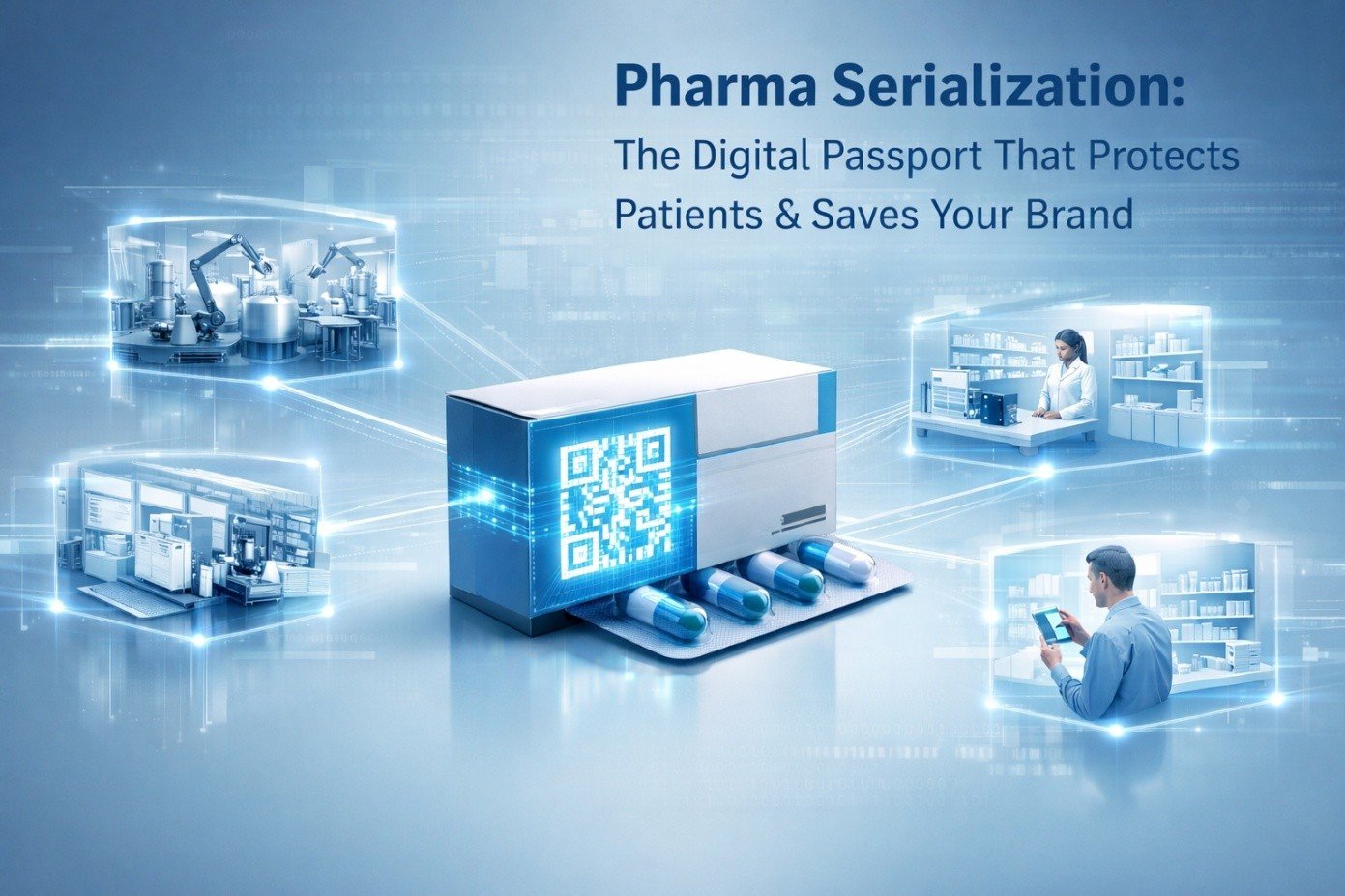
Pharma Serialization: The Digital Passport That Protects Patients & Saves Your Brand
Pharma serialization is no longer an optional system upgrade. It is a global compliance requirement and a critical step toward patient safety, anti-counterfeit protection, and supply chain transparency.
In today’s pharmaceutical world, trust is everything. Counterfeit medicines not only harm patients but also destroy trust in pharmaceutical brands.
That is why pharma serialization has become one of the most important compliance and business requirements globally. It is no longer just regulation — it is a supply chain survival strategy.
What is Pharma Serialization?
Pharma serialization means giving a unique identity to every saleable pack of medicine.
Just like every person has a unique Aadhaar number, every medicine pack receives a unique number that allows it to be tracked across the supply chain.
This identity typically includes:
- GTIN (Global Trade Item Number)
- Unique Serial Number
- Batch or Lot Number
- Expiry Date
This information is printed on packaging in the form of:
- 2D Data Matrix Barcode
- Human-Readable Text
Think of serialization as the digital passport of a medicine pack. It answers a powerful question:
“Is this medicine genuine, and where has it travelled?”
How Pharma Serialization Became a Global Rule
Serialization did not start because companies wanted it. It started because counterfeit medicines became a global threat.
Major regulatory milestones include:
- EU Falsified Medicines Directive (EU FMD)
- US Drug Supply Chain Security Act (DSCSA)
- Russia Track and Trace System
- China Pharmaceutical Traceability System
- Brazil ANVISA Traceability Program
The core objectives remain the same:
- Track pharmaceutical products
- Stop counterfeit medicines
- Protect patient safety
- Increase supply chain transparency
Serialization exists because trust now requires technology.
Why Pharma Serialization is Important
Patient Safety
Serialization ensures only genuine medicines reach patients and helps quickly identify suspicious products.
Brand Protection
Counterfeit medicines damage brand reputation, reduce sales, and create regulatory risks.
Faster Product Recalls
With serialization, companies can locate affected batches quickly and isolate them efficiently.
Supply Chain Transparency
Companies gain visibility into where products are located, which distributor holds them, and whether products have been diverted to unintended markets.
Serialization is not just compliance — it is insurance for your pharmaceutical brand.
How Pharma Serialization Works
Level 1 – Unit Serialization
Each saleable pack receives a unique serial number and 2D data matrix barcode.
Level 2 – Aggregation
Individual packs are grouped into cartons or shippers, creating a parent-child relationship between units and cases.
Level 3 – Regulatory Reporting
Serialization data is submitted to regulatory systems or shared with trading partners depending on country requirements.
Typical system architecture includes:
- Line Level Systems (printing and verification)
- Site Serialization Server (L3)
- Enterprise Serialization System (L4)
- Regulatory Gateway (L5)
If packaging lines are the hands, serialization software is the brain.
Major Pharma Serialization Challenges
Multiple Country Regulations
Each country requires different barcode formats, reporting templates, and aggregation rules.
Packaging Line Issues
- Barcode readability failures
- Printer quality problems
- Vision system rejects
- Reduced line speeds
Data Integrity Risks
Serialization data is GMP-critical and must meet strict data integrity requirements.
Aggregation Complexity
Rework scenarios, partial aggregation, and label reprinting create operational challenges.
Most serialization failures are not technical — they are coordination failures between IT, Quality, and Production.
Best Practices for Serialization Implementation
Start With Process Mapping
Define packaging workflows, exception handling, and data ownership before selecting vendors.
Define Data Governance
Organizations must clearly define who generates serial numbers, approves batches, and manages data retention.
Test Packaging Lines Early
Early testing helps identify scanner placement issues, printer drift, and label material problems.
SOP-Driven Exception Handling
Serialization operations require SOPs for rework, reject handling, downtime recovery, and reconciliation.
In serialization operations, exceptions are not rare — they are routine.
Pharma Serialization Consulting
Our consulting approach focuses on building sustainable serialization capabilities.
Gap Assessment
- Line readiness evaluation
- Compliance maturity review
- Data integrity risk analysis
Strategy & Design
- Serialization architecture
- Aggregation design
- Governance model
Implementation Support
- URS preparation
- Vendor coordination
- Packaging line commissioning
Validation & Compliance
- Risk-based validation
- IQ OQ PQ support
- Part 11 and Annex 11 compliance
Operational Excellence
- KPI dashboards
- Line performance improvement
- Serialization training
We do not just implement systems — we build a complete serialization ecosystem.
Conclusion
Pharma serialization is no longer just a regulatory requirement. It is a digital safety shield that protects patients and pharmaceutical brands.
With increasing counterfeit risks and global regulatory pressure, serialization enables companies to verify product authenticity, track movement, and respond quickly to recalls.
When implemented correctly, serialization becomes more than compliance — it becomes a strategic competitive advantage for pharmaceutical companies.